 EN
 KR
 ES
 AR


Common Flexible Insulation Materials in Distribution Transformers
Flexible electrical insulation materials used in distribution transformers are primarily applied in layer insulation, turn-to-turn insulation, end-ring wrapping, lead insulation, and phase-to-phase/ground isolation. These materials must combine high dielectric breakdown strength and thermal stability with sufficient mechanical flexibility, tear resistance, and impregnation compatibility to withstand bending and mechanical tension during coil winding.
Depending on the cooling and insulating medium of the distribution transformer (oil-immersed vs. dry-type), material selection systems differ significantly. Below is an overview of the most widely used flexible insulation materials in the industry and their applications:
1. Cellulose Paper-Based Materials (Primarily for Oil-Immersed Transformers)
Cellulose paper offers exceptional dielectric constant matching and impregnation compatibility with mineral insulating oil (as well as natural and synthetic ester fluids), making it the most cost-effective flexible insulation solution for oil-immersed distribution transformers.
- Standard Electrical Insulating Paper (Cable Paper / Telephone Paper):
- Features: Made from pure sulfate wood pulp, offering a soft texture, high oil absorption, and moderate mechanical strength, rated at Thermal Class A (105°C).
- Applications: Electromagnetic wire wrapping (turn-to-turn insulation), low-voltage coil layer insulation, and lead wrapping.
- Thermally Upgraded Paper (TUP / Cyanoethylated Paper / Dicyandiamide-Modified Paper):
- Features: Chemically modified to inhibit cellulose hydrolysis and thermal degradation at elevated temperatures, upgrading the thermal rating to Class E (120°C) or Class B (130°C) and significantly extending aging life.
- Applications: Layer and turn-to-turn insulation in high-load or compact oil-immersed distribution transformers.
- Electrical Crepe Paper:
- Features: Creped during manufacturing to achieve high elongation (typically 50%–200%) and conformability, preventing wrinkling or cracking when bent.
- Applications: Specifically designed for wrapping irregular geometries, such as coil leads, tap-changer connection leads, yoke corners, and end rings.
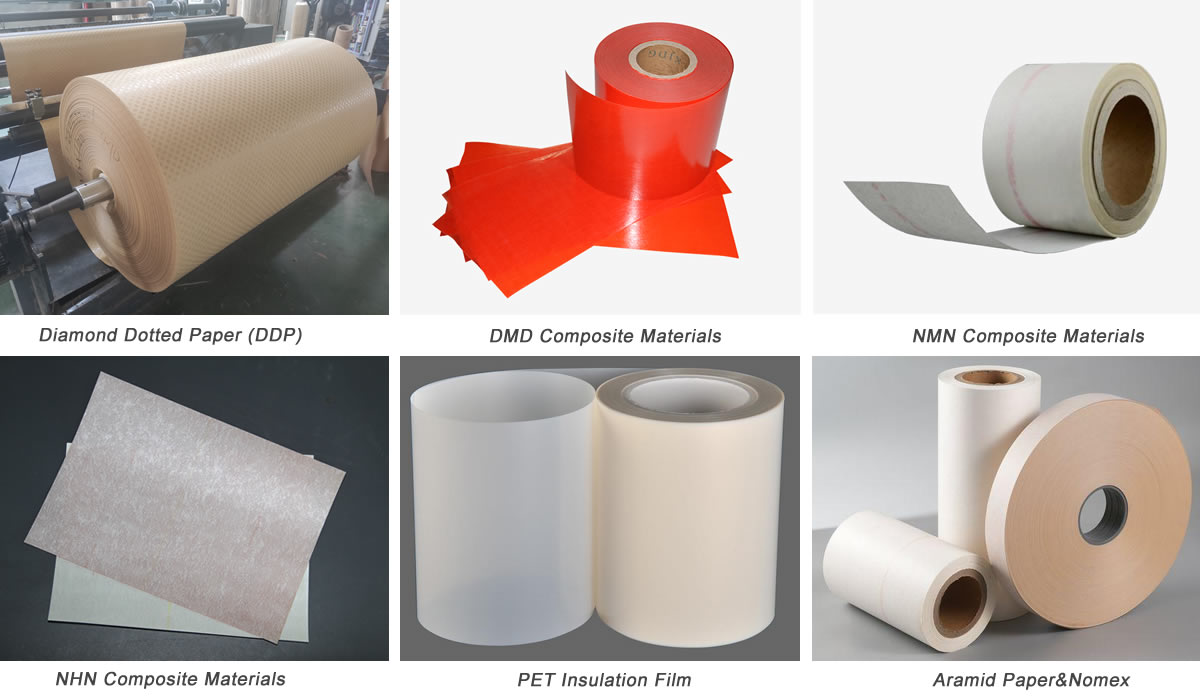
- Diamond Dotted Paper (DDP):
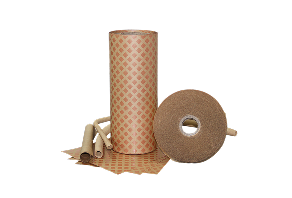
- Features: Electrical insulating paper or thermally upgraded paper coated with modified epoxy resin in a diamond-grid pattern. During winding drying and curing, the resin melts and cures to bond adjacent conductors and layer insulation into a rigid structure, while the uncoated channels allow smooth insulating oil penetration.
- Applications: Layer insulation in high- and low-voltage windings of oil-immersed distribution transformers, substantially enhancing mechanical resistance to short-circuit electromagnetic forces.
2. Films and Flexible Composite Materials (For Both Dry-Type and Oil-Immersed, Primarily Dry-Type)
Flexible composites typically utilize a three-layer structure (such as NMN) or two-layer structure combining a film (providing high dielectric strength) with non-woven fabric or insulating paper (providing mechanical protection, varnish absorption, and tear resistance).
| Material / Grade | Structure | Thermal Class | Key Features & Typical Applications |
|---|---|---|---|
| Polyester Film (PET / Mylar) | Pure polyethylene terephthalate film | Class E (120°C) | High dielectric strength, smooth surface, and moisture resistance, though with moderate tear and corona resistance. Commonly used as layer liners in dry-type transformers or as the core layer in composites. |
| DMD Composite materials | Polyester fiber non-woven + Polyester film + Polyester fiber non-woven | Class B/F (130–155°C) | High mechanical strength, good varnish absorption, and cost-effectiveness. Widely used for layer and phase-to-phase insulation in Class F non-encapsulated (VPI) dry-type transformers. |
| NMN Composite materials | Meta-aramid paper (Nomex) + Polyester film + Meta-aramid paper | Class F/H (155–180°C) | Combines the high-temperature and tear resistance of aramid with the high dielectric strength of polyester film, plus superior surface varnish absorption. Widely used for layer and end insulation in high-voltage dry-type transformers. |
| NHN Composite materials | Meta-aramid paper (Nomex) + Polyimide film (Kapton) + Meta-aramid paper | Class H (180°C+) | Top-tier heat-resistant flexible composite offering high thermal endurance, flame retardancy, radiation resistance, and exceptional dielectric stability. Used in high-overload dry-type and specialty transformers. |
| Pure Aramid Paper (Nomex 410 / 411) | 100% synthetic aromatic polyamide fiber calendered paper | Class H/C (180–220°C) | Inherently flame-retardant, neither melting nor supporting combustion at high temperatures, with outstanding corona and tear resistance. Used for layer, turn-to-turn, and end-ring insulation in open-wound (VPI) dry-type transformer windings. |
3. Varnished Fibrous Products and Banding Materials
These materials provide mechanical fastening, lead protection, and end-insulation reinforcement, typically cured alongside impregnating varnishes (such as polyester, epoxy, or silicone resins):
- Varnished Fiberglass Cloth / Sleeving (Varnished Cambric, Silicone Rubber Fiberglass Sleeving):
- Features: Woven from alkali-free fiberglass and coated with polyester, epoxy, or silicone resin, covering Thermal Classes B through H with high flexibility and abrasion resistance.
- Applications: Lead insulation sleeving, ground insulation protection for high-voltage leads, and protection for temperature sensor leads.
- Unidirectional Fiberglass Banding Tape:
- Features: Parallel alkali-free fiberglass filaments impregnated with thermosetting resin (B-stage), delivering ultra-high tensile strength and minimal elongation, shrinking tightly upon thermal curing.
- Applications: Replaces traditional steel bands for core limb banding (eliminating eddy current losses) and secures winding ends and leads.
- Heat-Shrinkable Tape and Polyester Crepe Tape:
- Features: Shrinks radially upon heating to conform tightly to conductor surfaces, eliminating air voids and increasing the Partial Discharge Inception Voltage (PDIV).
- Applications: Outer wrapping of dry-type transformer windings, busbar transition sections, and lead joint insulation.
4. Key Selection Criteria
In practical transformer insulation design, the selection of flexible materials balances four critical parameters:
Electrical Performance and Compatibility: Oil-immersed transformers prioritize oil absorption and low dielectric dissipation factor (avoiding films prone to swelling or leaching impurities in hot oil), whereas dry-type transformers emphasize partial discharge suppression and flame retardancy (UL94 V-0).
Thermal Class Alignment: Materials must strictly match the overall insulation system temperature rating (e.g., 105°C/120°C for oil-immersed units; Class F 155°C or Class H 180°C for dry-type units).
Mechanical Short-Circuit Withstand Capability: Following thermal curing or varnish impregnation, layer materials must form a strong bond with conductors (such as DDP or resin-impregnated composites) to prevent axial or radial instability during short-circuit events.
Processability: High-speed automated winding machines require specific tensile strength and stiffness—materials that are too soft may cause feeding jams, while overly rigid materials are prone to micro-cracking along folded edges.