I. What Is a Fiberglass Filament Wound Tube End Ring?
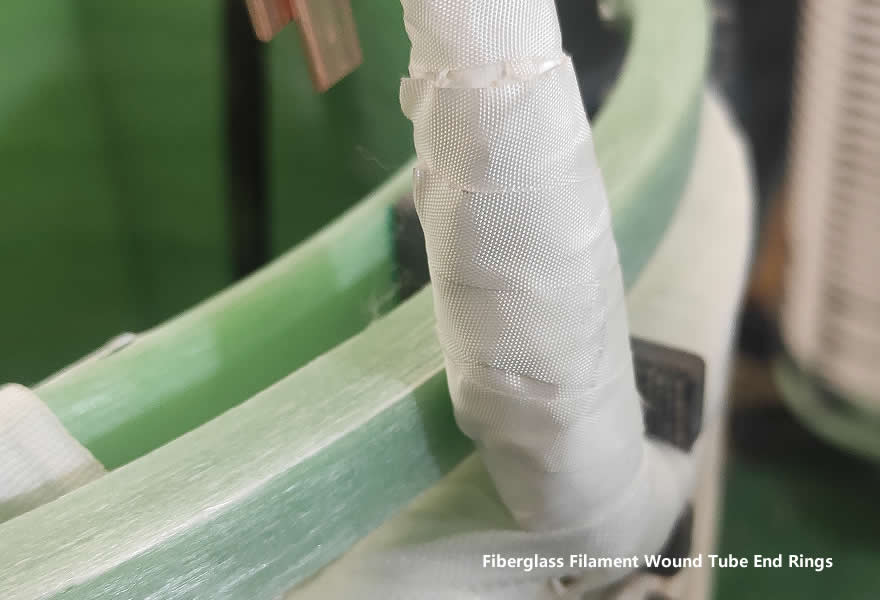
Fiberglass filament wound tube end ring is an insulating structural component manufactured from alkali-free glass fiber and epoxy resin using a filament winding process, then cut into ring or semi-ring shapes according to design requirements. It is widely used at the end sections of windings in dry-type transformers.
Common names include:
Fiberglass filament wound end ring
Insulating end ring
Winding end support ring
GFRP End Ring / Filament Wound Tube Ring
II. Installation Position in Dry-Type Transformers
Location:
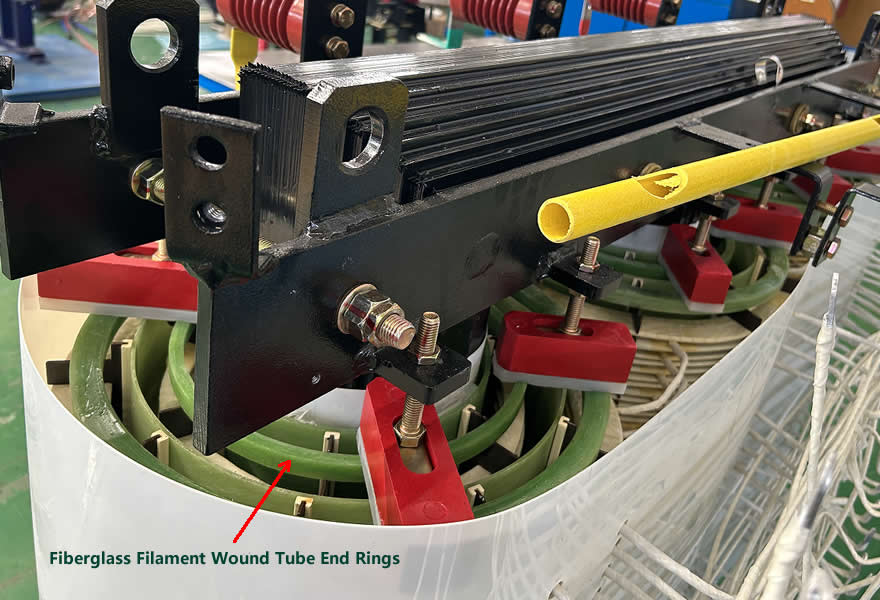
- Installed at the upper and lower ends of high-voltage or low-voltage windings
- Positioned between the winding ends and metal clamping plates as part of the end support system
Typical structural arrangement:
Clamping plate
Fiberglass filament wound end ring
Winding end
Spacer / air duct structure
III. Main Functions and Roles
1. End Insulation and Electrical Isolation
- Provides high dielectric strength to isolate winding ends from metal clamping components
- Prevents creepage, partial discharge, and flashover
- Suitable for 10 kV, 20 kV, and 35 kV dry-type transformers
2. Mechanical Support and Structural Stability
- Bears axial compressive forces at winding ends
- Prevents deformation and axial displacement under short-circuit conditions
- Improves short-circuit withstand capability
3. Electric Field Optimization and Partial Discharge Reduction
- Smooths electric field distribution at winding ends
- Reduces electric field concentration points
- Lowers partial discharge (PD) levels
4. Thermal Resistance and Service Life Improvement
- Suitable for Class F (155°C) and Class H (180°C) insulation systems
- Maintains stable performance without softening or carbonization
IV. Why Dry-Type Transformers Rely on Fiberglass End Rings
| Item | Dry-Type Transformer |
|---|
| Insulation medium | Solid insulation + air |
| Cooling method | Natural air / forced air |
| Partial discharge risk | Higher |
| End structure strength requirement | Higher |
Advantages of fiberglass filament wound end rings:
- Low moisture absorption and excellent dimensional stability
- High mechanical strength compared to paper-based insulation
- No oil compatibility limitations, ideal for dry-type transformers
V. Key Performance Requirements
| Property | Typical Requirement |
|---|
| Dielectric strength | ≥ 20 kV/mm |
| Volume resistivity | ≥ 1012 Ω·cm |
| Flexural strength | ≥ 300 MPa |
| Compressive strength | ≥ 250 MPa |
| Thermal class | Class F / Class H |
| Water absorption | ≤ 0.2% |
VI. Selection Guidelines and Considerations
1. Selection by Voltage Class
- 10 kV: Standard fiberglass filament wound end rings
- 20–35 kV: Increased wall thickness and high-density filament wound tubes recommended
2. Selection by Mechanical Strength
- For dry-type transformers ≥ 2500 kVA, axial compressive strength is critical
- Ordinary FR4 laminated boards assembled into rings are not recommended
3. Surface Quality and Machining
- Smooth inner and outer surfaces without burrs
- Flat cut edges to avoid local electric field concentration
- Chamfered or rounded edges when required
VII. Summary
Fiberglass filament wound tube end rings are essential insulating and structural components in dry-type transformers, providing high dielectric strength, excellent mechanical support, thermal resistance,and superior short-circuit performance, helping reduce partial discharge and extend transformer service life.


 EN
EN  KR
KR  ES
ES  AR
AR