 EN
EN  KR
KR  ES
ES  AR
AR 

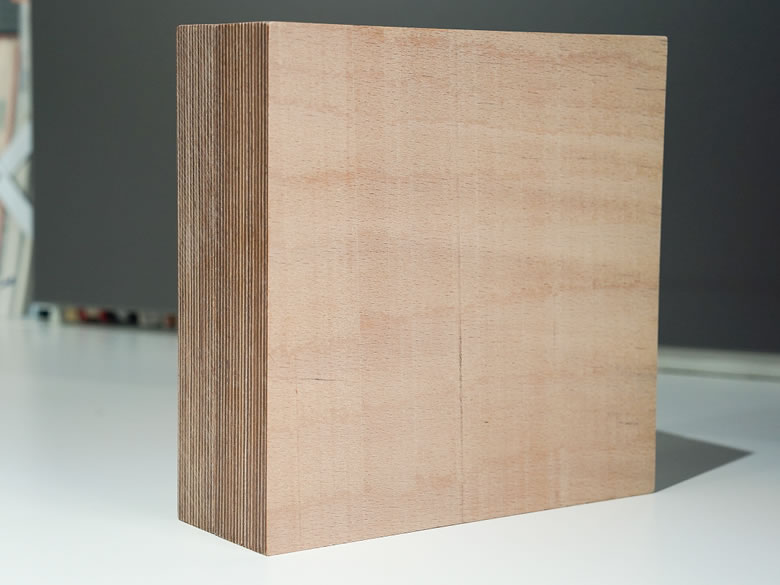
Electrical Laminated Wood is a high-performance insulating material specially designed for electrical insulation and structural support in electrical equipment. It is typically manufactured from Birch and Beech veneers through a series of processes including drying, insulating resin impregnation, veneer lamination, and high-temperature, high-pressure hot pressing and curing.
Electrical laminated wood offers excellent electrical insulation, mechanical strength, dimensional stability, and machinability, as well as relatively low density and good resistance to transformer oil. It is particularly suitable for insulation and structural components in oil-immersed transformers and other electrical equipment.
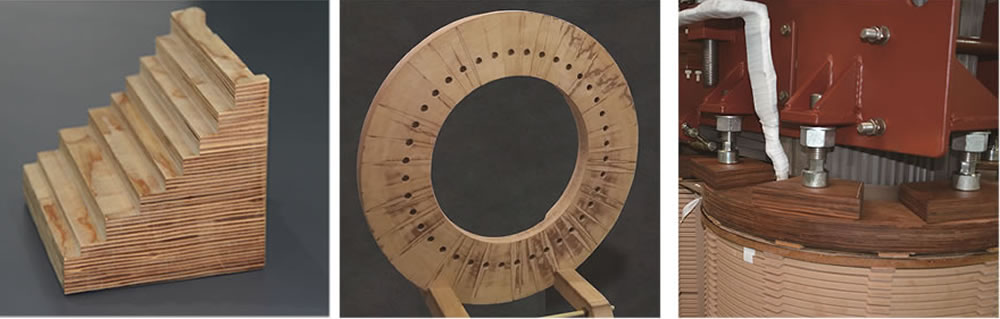
Electrical laminated wood is mainly used as an insulating and structural support material in transformers and instrument transformers. It can be machined into various components, including:
Electrical laminated wood features a moderate density, high mechanical strength, excellent suitability for vacuum drying, good compatibility with transformer oil, and good machinability. Its dielectric constant is close to that of transformer oil, providing good dielectric compatibility within transformer insulation systems. It can be used for long-term operation in transformer oil at temperatures of up to 105°C.
Electrical laminated wood has been widely used in oil-immersed transformers to manufacture upper and lower pressing plates, lead support brackets, special yoke spacer blocks, and other structural insulation components. In instrument transformers, it is also used for manufacturing clamping components.
Compared with conventional materials such as steel plates, insulating paperboard, epoxy paper laminates, and epoxy glass-cloth laminates, electrical laminated wood can help reduce the overall weight of transformers while also reducing material costs in suitable applications.
Standard: GB/T 20634.3-2008 / IEC 61061-2:1998
| Item | Unit | DLW101 | DLW201 | DLW202 | DLW301 |
| Appearance | – | Smooth surface, neat edge cutting, no layered cross-section | |||
| Density | g/cm³ | 1.2–1.3 | 1.1–1.2 | 1.1–1.2 | 1.0–1.1 |
| Vertical layer bending strength – A direction | MPa | ≥80 | ≥65 | ≥65 | ≥55 |
| Vertical layer bending strength – B direction | MPa | ≥80 | ≥65 | ≥65 | ≥55 |
| Impact strength – A direction | kJ/m² | ≥15 | ≥13 | ≥13 | ≥10 |
| Impact strength – B direction | kJ/m² | ≥15 | ≥13 | ≥13 | ≥10 |
| Interlayer shear strength | MPa | ≥9 | ≥8 | ≥8 | ≥7 |
| Vertical layer electrical strength (90°C transformer oil) | kV/mm | ≥9 | ≥8 | ≥7 | ≥7 |
| Parallel layer breakdown voltage (90°C transformer oil) | kV | ≥50 | ≥50 | ≥50 | ≥50 |
| Pollution to liquid dielectric | – | ≤0.1 | ≤0.1 | ≤0.1 | ≤0.1 |
| Shrinkage after drying – A direction | % | ≤0.3 | ≤0.3 | ≤0.3 | ≤0.3 |
| Shrinkage after drying – B direction | % | ≤0.3 | ≤0.3 | ≤0.3 | ≤0.3 |
| Shrinkage after drying – Thickness direction | % | ≤3 | ≤3 | ≤3 | ≤3 |
| Water content | % | ≤6 | ≤6 | ≤6 | ≤6 |
| Oil absorption | % | ≥5 | ≥8 | ≥8 | ≥10 |
| Laminated wood insulating parts in the transformer using range | Transformer rating | ≤110 KV | ≥110 KV | 66–35 KV | ≥35 KV |
Electrical laminated wood can be manufactured using different types of wood veneers. Birch and Beech are two commonly used materials for electrical laminated wood.
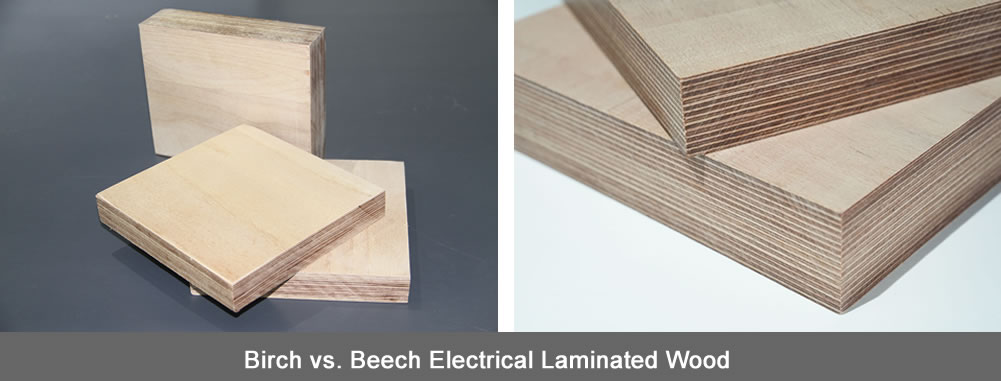
| Comparison | Birch Laminated Wood | Beech Laminated Wood |
|---|---|---|
| English Name | Birch Laminated Wood | Beech Laminated Wood |
| Wood Structure | Fine, dense, and uniform grain structure | Uniform structure with more pronounced grain |
| Density | Generally relatively high | Generally relatively high |
| Mechanical Strength | High, particularly suitable for load-bearing structures | High, with good overall mechanical performance |
| Bending Strength | Good | Good |
| Impact Resistance | Good | Good to excellent |
| Dimensional Stability | Good | Good |
| Machinability | Good | Very good |
| CNC Machining | Suitable | Suitable |
| Electrical Insulation | Good | Good |
| Transformer Oil Resistance | Good | Good |
| Typical Applications | Load-bearing, support, and insulation components in transformers | Support and insulation components in transformers |
| Key Material Characteristics | Excellent strength and structural uniformity | Excellent toughness and machinability |
From the perspective of transformer manufacturers, the difference can be simply understood as follows:
Birch: More focused on strength, uniformity, and load-bearing capability.
Beech: More focused on toughness, machinability, and overall balanced performance.
However, it is important to note that it is not accurate to simply say that Birch is always stronger than Beech or that Beech is always better than Birch.
The final performance of electrical laminated wood depends not only on the type of wood used, but also on a combination of manufacturing and material factors, including:
Wood grade → Veneer thickness → Moisture content → Resin type → Resin content → Impregnation process → Lamination structure → Hot pressing temperature and pressure → Post-treatment
Therefore, the appropriate material should be selected according to the transformer design, mechanical load, insulation requirements, operating conditions, machining requirements, and applicable standards.